Publications
Publications by categories in reversed chronological order.
2023
-
 Short-Interval Priming Effects: An EEG Study of Action Observation on Motor ImageryZiqi Sun, Yi-Chuan Jiang, Yishu Li, and 2 more authorsIEEE Transactions on Cognitive and Developmental Systems, Dec 2023
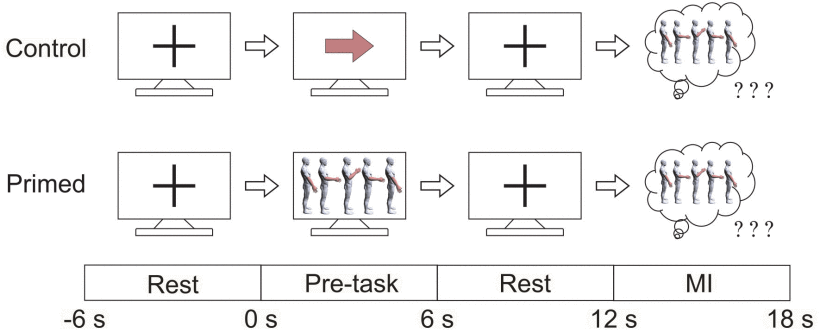
How to effectively set and adjust training tasks is the main challenge of task-oriented rehabilitation. Recent studies have shown that motor priming effects could be used as an important reference for task setting. However, the use of assessment scales to quantify priming effects lacks timeliness. This study focused on evaluating the motor priming effects on a smaller timescale using electroencephalogram (EEG). Six healthy adults were recruited to perform motor imagery (MI) of elbow flexion extension primed by the same action observation (AO). The control task replaced AO with arrows indicating different elbows. The motor priming effects were evaluated by the event-related desynchronization (ERD) of }mu band (8–13 Hz) power and single-trial classification of left or right elbow MI. Both ERD intensity and classification accuracy of MI primed by AO were more significant than MI instructed by arrows. The results demonstrated that short-interval motor priming effects could be evaluated at the neural level and could be used as feasible neurofeedback to guide task-oriented rehabilitation.
2022
-
 Characterization of Bimanual Cyclical Tasks From Single-Trial EEG-fNIRS MeasurementsYi-Chuan Jiang, Rui Ma, Shichen Qi, and 5 more authorsIEEE Transactions on Neural Systems and Rehabilitation Engineering, Dec 2022
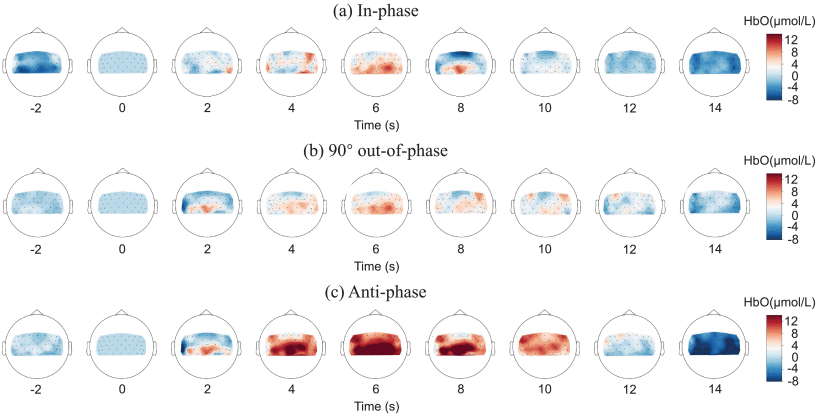
Robot-assisted bimanual training is promising to improve motor function and cortical reorganization for hemiparetic stroke patients. Closing the rehabilitation training loop with neurofeedback can help refine training protocols in time for better engagements and outcomes. However, due to the low signal-to-noise ratio (SNR) and non-stationary properties of neural signals, reliable characterization of bimanual training-induced neural activities from single-trial measurement is challenging. In this study, ten human participants were recruited conducting robot-assisted bimanual cyclical tasks (in-phase, 90° out-of-phase, and anti-phase) when concurrent electroencephalography (EEG) and functional near-infrared spectroscopy (fNIRS) were recorded. A unified EEG-fNIRS bimodal signal processing framework was proposed to characterize neural activities induced by three types of bimanual cyclical tasks. In this framework, novel artifact removal methods were used to improve the SNR and the task-related component analysis (TRCA) was introduced to increase the reproducibility of EEG-fNIRS bimodal features. The optimized features were transformed into low-dimensional indicators to reliably characterize bimanual training-induced neural activation. The SVM classification results of three bimanual cyclical tasks revealed a good discrimination ability of EEG-fNIRS bimodal indicators (90.1%), which was higher than that using EEG (74.8%) or fNIRS (82.2%) alone, supporting the proposed method as a feasible technique to characterize neural activities during robot-assisted bimanual training.